Etienne De Crecy Live 2007 Transmusicales de Rennes from Clement bournat on Vimeo.
Wednesday, May 27, 2009

Thursday, May 21, 2009
The Brain Unmasked

In August 2008, MIT Technology Review reported on how new imaging technologies are revealing the intricate architecture of the brain, by creating a series of highly-detailed, and never seen before, blueprints of its dense connectivity.
The typical brain scan shows a muted gray rendering of the brain, easily distinguished by a series of convoluted folds. But according to Van Wedeen, an Associate Professor in Radiology at Harvard, that image is just a shadow of the real brain. A new technique called Diffusion spectrum imaging (DSI) uses magnetic resonance signals to track the movement of water molecules in the brain: water diffuses along the length of neural wires, called axons. Scientists can use these diffusion measurements to map the wires, creating a detailed map of the brain's connectivity.
GREAT VIDEO!Friday, May 15, 2009


Andrea Zittel's
Me encanta la manera en la que Andrea Zittel redacta algunos de los problemas que enfrentamos en el proceso creativo y otros aspectos que tienen que ver con la existencia humana. Definitivamente da una especie de alivio leer de forma tan clara pensamientos que son tan complicados de definir y decir.
Les invito a que visiten su sitio web y vean el maravilloso trabajo gráfico que realizo para estas ideas.
Andreas Zittet's - These things I know for sure:
1. It is a human trait to want to organize things into categories. Inventing categories creates an illusion that there is an overriding rationale in the way that the world works.
2. Surfaces that are “easy to clean” also show dirt more. In reality a surface that camouflages dirt is much more practical than one that is easy to clean.
3. Maintenance takes time and energy that can sometimes impede other forms of progress such as learning about new things.
4. All materials ultimately deteriorate and show signs of wear. It is therefore important to create designs that will look better after years of distress.
5. A perfected filing system can sometimes decrease efficiency. For instance, when letters and bills are filed away too quickly, it is easy to forget to respond to them.
6. Many “progressive” designs actually hark back towards a lost idea of nature or a more “original form.”
7 Ambiguity in visual design ultimately leads to a greater variety of functions than designs that are functionally fixed.
8. No matter how many options there are, it is human nature to always narrow things down to two polar, yet inextricably linked choices.
9. The creation of rules is more creative than the destruction of them. Creation demands a higher level of reasoning and draws connections between cause and effect. The best rules are never stable or permanent, but evolve naturally according to context or need.
10. What makes us feel liberated (and consequently more creative) is not total freedom, but rather living in a set of limitations that we have created and prescribed for ourselves.
11. Things that we think are liberating can ultimately become restrictive, and things that we initially think are controlling can sometimes give us a sense of comfort and security.
12. Ideas seem to gestate best in a void—when that void is filled, it is more difficult to access them. In our consumption-driven society, almost all voids are filled, blocking moments of greater clarity and creativity. Things that block voids are called “avoids.”
13. Sometimes if you can’t change a situation, you just have to change the way that you think about the situation.
14. People are most happy when they are moving forwards towards something not quite yet attained. (I also wonder if this extends as well to the sensation of physical motion in space… I believe that I am happier when I am in a plane or car because I am moving towards an identifiable and attainable goal.)
Wednesday, April 8, 2009
Tuesday, April 7, 2009
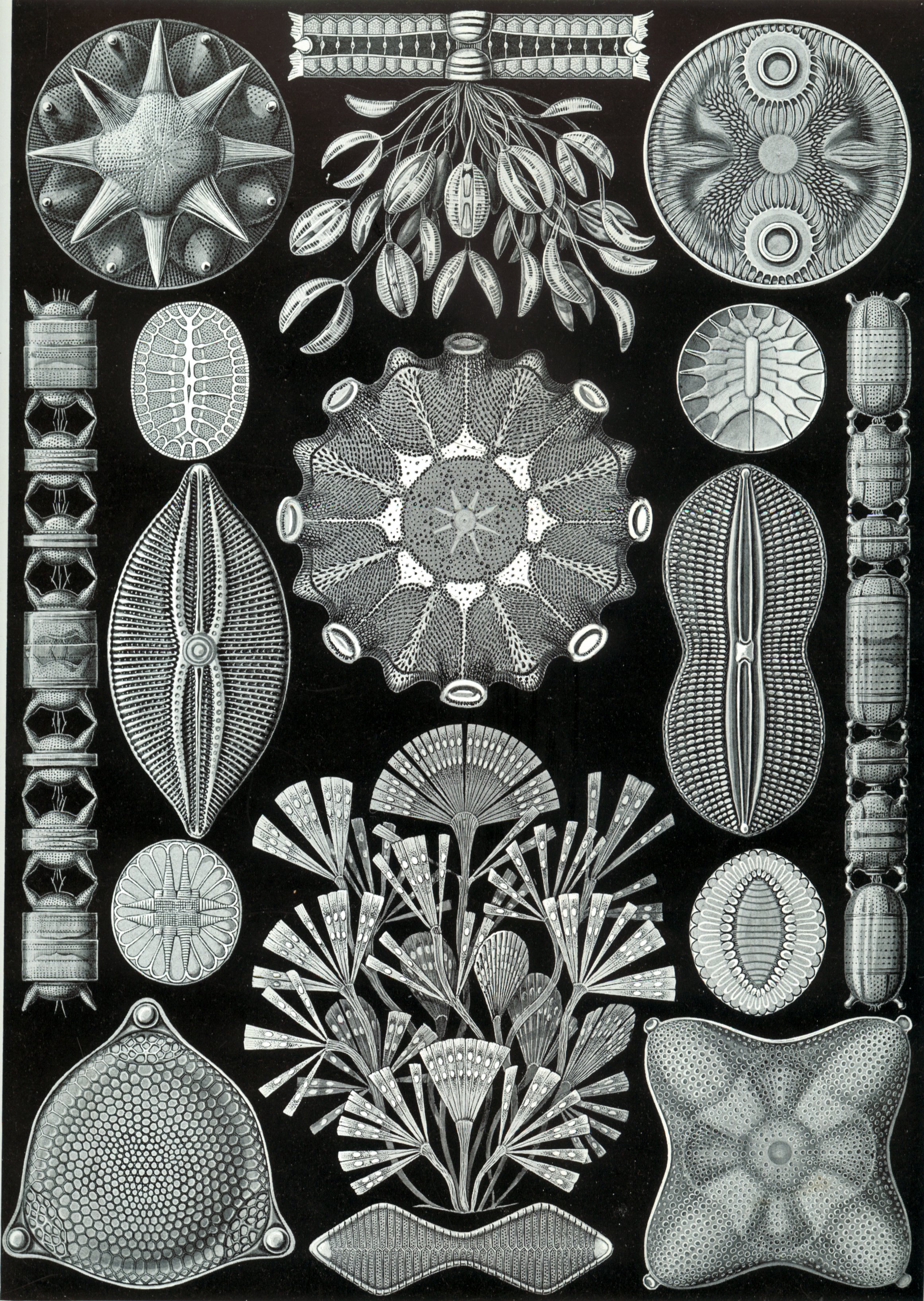
Diatoms

It's the kind of thing you actually never think about, at least you are a scientist. Diatoms are a unicellular phytoplankton molecule made out of silica (glass), principally in charge of producing 45% of the oxygen in the water and there are aprox. 10,000 existing species (WTF!?)
They are a very interesting product of nature and a constant reference for artists and designers either because of their wonderful structures, textures, colors or shapes. Therefore, there's a Projektmodule this semester at the University call "Diatommen", that aims to create and interdisciplinary team of media artist, product designers and architects to conceptualize and make a special exhibition for the Phyletic Museum in Jena. I have an interview to join the crew beforehand and if I pass it, I am quite sure these diatoms will produce a lot oxygen in the blood cells of my imagination.
And there is more, the museum was founded by the great illustrator and scientist Ernst Haeckel, who's already a big inspiration to my work. The funny thing is that I didn't know it until yesterday, when the course was presented to the Mediengestaltung students... life is full of small coincidences.
Subscribe to:
Posts (Atom)